
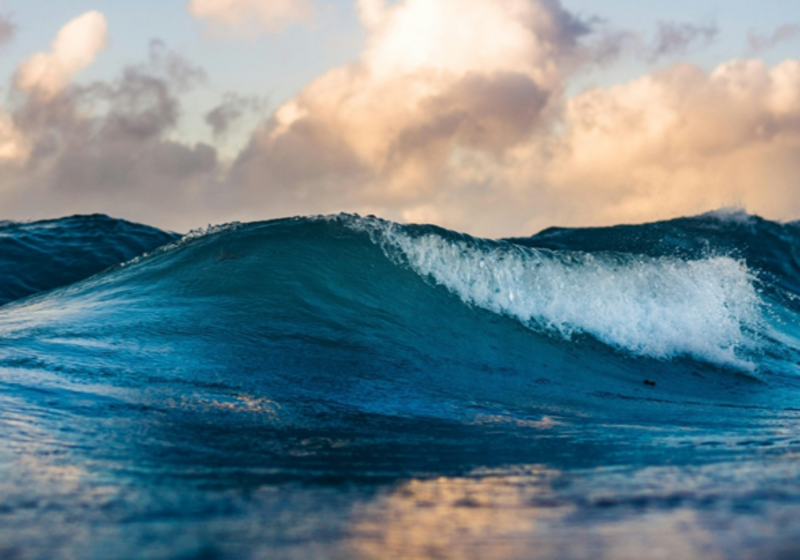
Silas Baisch on unsplash
Karen Hollis |August 9, 2026 11th Sunday after Pentecost
Matthew 14:22-33 Immediately he made the disciples get into a boat and go on ahead to the other side, while he dismissed the crowds. And after he had dismissed the crowds, he went up the mountain by himself to pray. When evening came, he was there alone, but by this time the boat, battered by the waves, was far from the land, for the wind was against them. And early in the morning he came walking toward them on the sea. But when the disciples saw him walking on the sea, they were terrified, saying, "It is a ghost!" And they cried out in fear. But immediately Jesus spoke to them and said, "Take heart, it is I; do not be afraid." Peter answered him, "Lord, if it is you, command me to come to you on the water." He said, "Come." So Peter got out of the boat, started walking on the water, and came toward Jesus. But when he noticed the strong wind, he became frightened, and, beginning to sink, he cried out, "Lord, save me!" Jesus immediately reached out his hand and caught him, saying to him, "You of little faith, why did you doubt?" When they got into the boat, the wind ceased. And those in the boat worshiped him, saying, "Truly you are the Son of God."
Let us pray . . . May the words of my mouth and the meditations of all our hearts be reflections of your word to us today, in Christ’s name we pray. Amen
You may remember the 2011 earthquake that caused a massive tsunami in Japan. The tsunami wasn’t like the kind you see in movies. It didn’t come as a wall of water that crashed over everything. Instead, it was a wave that washed up on shore and just kept coming. It went up the beach, between houses, continued up the street, lifting buckets, outdoor toys, wheelbarrows, bicycles, debris, and cars as it went. The video I remember was taken from a high spot a few blocks from the beach. The water level just kept rising until the water was everywhere, all you could see was a seascape populated with roofs and bobbing cars. The ocean and the sea are not solid, so when they rise up, in a sense, they are simply doing what water does, responding to the forces that act upon it . . . but it feels like chaos. Like the world has been upended and we are powerless in the face of it. The strength of it, the reality of it is just overwhelms . . . still, when we are faced with forces in the world that are beyond our control, we continue to have agency over how we respond.
At the end of a long day, at the edge of the water, Jesus puts Peter and the other disciples into a boat and sends them across the sea ahead of him. Predictably, in terms of the narrative and the common conditions on the Sea of Galilee, a headwind picks up. The waves soon follow . . . the force grows until it’s like a wall, you’re just not going to overcome it. Maybe you’ve had this kind of experience or found yourself paddling against a current and look over to the shore to see that you’re just paddling in place. It can be all the more defeating and exhausting to know that you’re trying so hard and not going nowhere. The disciples are stuck in place, as wave after wave crashes around them and somehow, their boat stays upright. But there is no rest for them. Perhaps they take turns paddling and watching out for danger. Their senses are overloaded, adrenaline pumping, in full-on survival mode. They paddle on, fighting against the wind and waves and fighting for their lives, hour after hour in the black of night. With the first light of morning, Jesus catches up to them, walking on the water in the midst of the storm, giving them the biggest fright of the night.
Jesus calls out to them the words that anyone familiar with scripture would expect in a situation like this: "Take heart, it is I; do not be afraid." He tells them to take heart, be encouraged and be of good courage. They’re locked into their fear response after the night they’ve had, so perhaps this is an invitation to move back into the space of the heart.
Jesus continues: “It is I,” which could also be translated “I am,” an invocation of the divine name. Like God moving over the waters in Creation, Jesus represents the divine presence with them right there in their fear and struggle, their fight and panic.
Then he says “do not be afraid”: God says it to Abraham, to Joseph in his many coloured coat, Moses says it to the Israelites, God proclaims it numerous times through the prophet Isaiah to a people without a home and without an identity, the angel Gabriel says it to Mary, an angel says it to the women at the open tomb, and Jesus says it to his disciples over and over again . . . do not be afraid.
The holy offers this reminder over and over again to us because we are human and when danger comes, our biology initiates a fear response. The storm is scary. They’ve been fighting for their lives and now as this figure appears, what are they even seeing? And in the midst of their fear, they have a limited view, their curiosity has shut down, and have lost their critical thinking.
Peter speaks: “if it is you, tell me to come to you on the water.” Peter often gets praise here for his great courage . . . perhaps it is courage or perhaps it’s something else. Let’s pause here and review the events one more time.
The disciples are afraid for their lives among the wind and waves, Jesus approaches them on the water and tells them who he is, and then Peter responds with a question to assess whether he is telling the truth. Perhaps Peter is delirious; perhaps he doesn’t trust his own perception. Jesus’ response will tell him if Jesus is real or not.
In his fear state, Peter’s first instinct is to suspicion and distrust that it is really Jesus, that it is really the holy.1 His instinct is to test the one who has appeared before them. Perhaps Peter is looking for a grand gesture from the holy - a gesture the size of his fear - to make him believe beyond a shadow of a doubt. Imagining Peter’s motivation, theologian, Debie Thomas writes: “If it’s you, enable me to do the impossible. If it’s you, make magic happen so that I will be dazzled out of all doubt . . . reorder reality and prove to me that you’re God.”2
It’s as if the truer storm is within him. It reminds me of Jacob wrestling with the holy in human form on the bank of the Jordan river. Jacob stays in it all night, in the struggle with himself, his identity, his role, his relationship with God, who is mystery AND faithful companion. Even after this very physical and present encounter that names him and changes him, Jacob is still left with the mystery.
Peter wrestles with God and proceeds to the edge to know the truth beyond doubt . . . but his test fails. While Jesus is real, Peter is not able to do the impossible. As he steps out of the boat, the conditions remain wild: the winds blow and the waves crash around him, the water is not solid and he is undone. His fear takes him to the edge, and he is saved only by grace.
Jesus waits until their back in the boat to calm the storm . . . perhaps it is there in the calm that Peter begins to come back to himself, to see the cracks emerge in his black and white thinking. If God isn’t going participate in his test, it doesn’t mean the holy is not present. The holy accompanies us in many ways, in bold and luminous ways and in soft and quiet ways. The wildness of the sea, instability of the world order, the fierceness of the wildfires are no proof of God’s absence.3 There is no need to run head long into danger to confirm that it’s true.
As we feel the power of the water beneath us, we know that we are still afloat. We are also not powerless. In fact, we have immense power to acknowledge our fear AND clarify our understanding of our circumstances, reach out to one another, discern reasonable action, and take the next right step. Sometimes reasonable action leads us to the edge of our own becoming and the holy meets us there to see beyond what we had previously known. Like the buoyant force that keeps the boat afloat, God comes around us without fail, and meets us exactly where we are.
1 Thomas, Debie. Into the Mess. p. 89.
2 Ibid.
3 Ibid, 90