
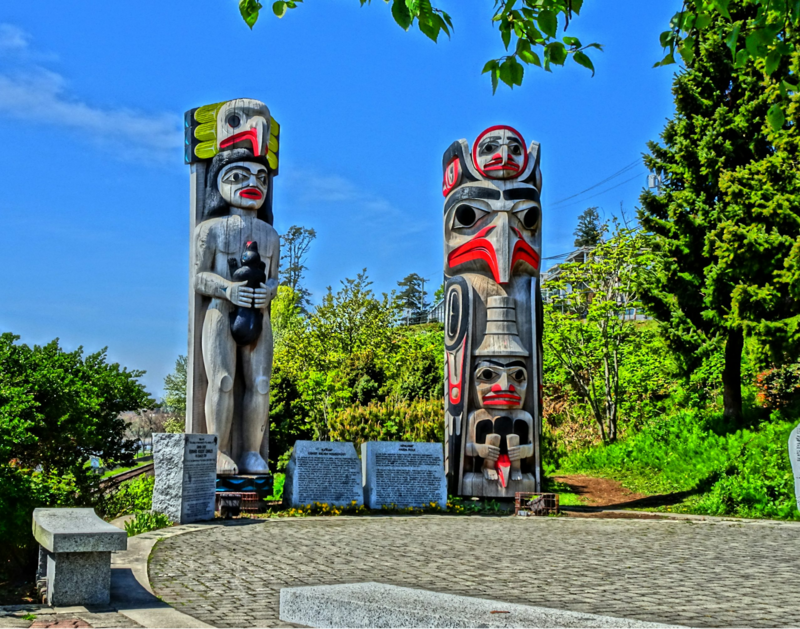
Photo by Joe Mabel
Karen Hollis | June 21, 2026 Indigenous People’s Day
Matthew 10:1, 12-23 Creator Sets Free (Jesus) then gathered his twelve message bearers together to prepare them for this great harvest. He gave them authority over evil and unclean spirits, to force them out of people, and to heal all kinds of sickness and disease. There were originally twelve tribes of Wrestles with Creator (Israel). This may be why he chose twelve message bearers. When you come to their dwelling, greet the family with respect. If they are people of honour, your greeting of peace will rest on them.
But if no one in that village welcomes you or listens to your message, then go from there and shake the dust from your moccasins. The truth is, on the day when the fate of that village is decided, it will be worse for them than it was for Village of Bad Spirits (Sodom) and Village of Deep Fear (Gomorrah). Look and listen! I am sending you out like sheep into a pack of wolves, so be as crafty as snakes but as harmless and gentle as doves. Look out for men with bad hearts, for they will bring you before their councils and whip you with leather straps in their gathering houses. You will also be dragged before government rulers and leaders – all because you are representing me – and in this way through you both the tribes and Wrestles with Creator (Israel) and the People of Iron (Romans) will hear my message. When this happens, do not be afraid or worry about what you will say or how you will say it. When that time comes, you will be given the words to say.
Let us pray . . . May the words of my mouth and the meditations of all our hearts be reflections of your word to us today, in Christ’s name we pray. Amen
With summer upon us, some of us are settling in for a beautiful season here at home, I mean why would we need to go anywhere else? Everything we need is right here. Forests, ocean, mountains, sunny days, warm weather. Still, summer has for a long time been the season of pilgrimage in the church. Pilgrimage is of course a journey that has both a physical and spiritual component. We set out from home around the neighbourhood or across the country, and engage what the road and the journey have to offer, and eventually returning to the place we started with a new perspective.
Whenever we set out on such a journey, we make sure we have everything we need: keys, wallet, water, sunhat, trekking poles, camping gear, change of clothes, food. It’s perfectly normal to pack before we leave home. We didn’t hear this part of the story this morning, but you may remember that Jesus sends the 12 without any supplies. They journey at a time where it was expected that people take travellers into their home. That was, of course, the transgression of Sodom and Gomorrah, their lack of hospitality. The message bearers set off on their pilgrimage, carrying with them only the message of Christ, authority given them by Jesus, and the Holy Spirit, who will inspire them when words in critical situations.
Jesus sends them with confidence that those three things will be sufficient, because when they go to a home where the message of Christ is welcomed, all are blessed and all are housed, fed, cared for, and healed. When they are not welcomed, the spirit is present to help them navigate through circumstances that Jesus suggests could be quite complex and difficult.
You don’t know what you’re going to get when you knock on someone’s door. It seems the presence of Christ’s message naturally evokes a response, and so reveals what was already there, love or fear. It’s like the message of Christ is particularly gifted at unpacking boxes, regardless of what lives inside. The message of Christ resonates with love and does not impose where fear sends it away, though perhaps something happens when fear is witnessed.
It must have been the work of Love in our midst that identified the need for Truth and Reconciliation with First Nations. 11 years ago, just before we moved to Canada, the TRC report was published. The report has been met with both love and fear. Since then, the public has been learning not only about the horrific experiences in residential schools, but about the injustices that were done from the very beginning of contact . . . injustices on which communities like ours were built. Communities like ours were built on fear of the other, fear of what colonizers didn’t understand, fear of losing control, systemic oppression of people and a great deal of harm . . . there is so much underneath the surface in our midst . . . and the work of love is revealing it to us slowly.
The work of love in our midst, which, here in a Christ-centered context, we might name as Christ, is inviting us into some (hopefully) constructive discomfort. I’m thinking specifically about last year’s court decision in the lower mainland between the Cowichan Nation and Canada. The court decided that the Cowichan Nation holds Aboriginal title to lands at Tl’uqtinus (t’uk-tinas) on the Fraser River. While the lawsuit never included private property, the public immediately asked an understandable question, “what about my home? What about private property? I hear so much about reconciliation . . . how will it impact me and my family and my neighbourhood?
What does reconciliation mean for what is important to me?” The underlying fear there seems to be: could someone come and take my home? It seems the impact for many who have learned about the court decision is a bit of a reframe or an awakening. Suddenly for many people it is personal. While it isn’t comfortable, it seems the unfolding of events is unpacking our boxes a bit and we can see some more of what’s in there.
And if we take the role of the observer for a moment, and zoom out and look at the larger context and history of this situation, being fearful that someone might take one’s home is quite a reversal. The fear we feel that we could be forced out needs to speak to us of the massive act of injustice was done here . . . that our towns and neighbourhoods were not built on the strong foundation that we were all taught, but on layer upon layer of brutality and oppression. It’s devastating and heartbreaking.
According to JFK Law Firm, “the specific history at Tl’uqtinus (t’uk-tinas) makes the injustice particularly stark. Colonel Richard Moody was the Crown official tasked with setting aside reserve lands for Indigenous people at their settlements. Instead of fulfilling this responsibility, Moody covertly sold some of these lands at Tl’uqtinus (t’uk-tinas) to himself as a land speculator” and the government of BC is the source of the title on what the Court has now declared to be Cowichan Nation Aboriginal title lands. “As the Court found: ‘the situation we find ourselves in today is the product of the Crown’s failure to address the Cowichan claim, historically, and in modern times’” (at para. 3550).1
As I’ve said here before, we didn’t build this house, but we have inherited it and our fear is telling us that the situation isn’t right.
In a sense, with this court decision, many have experienced the work of love or reconciliation or Christ (they’re all intertwined here) knock at our own doors. As the text describes, there is an invitation to say welcome, though no one is pressured. There is an invitation to learn about land rights and the people groups whose lands were stolen, to practice curiosity and move toward understanding, and eventually to connection and collaboration.
We might think of it in terms of story. We were taught the colonial story that resources are for consuming and there isn’t enough for everyone. We learned that we have to hold on to what we have: our property, our status, our roles and vocations, our systems, our culture, because they might be taken away. It’s us or them. But what if Christ is knocking on our doors, inviting us to his practice of peace, of healing and reconciliation? What if he comes with a vision to do more than bring justice for first nations. What if reconciliation can lead us all in the process of writing a new story, one that all of us need. A story of working together in collaboration, of sharing, of mutual care, of love . . . a story of oneness with all of creation.
Love is big work, it is not easy. It is slow and it is enduring. It calls us to embark on a pilgrimage of learning and processing to understand what reconciliation means for us, and then returning home with new eyes . . . thanks be to God.
1 https://jfklaw.ca/cowichan-tribes-and-private-property-separating-fact-from-fiction/ June 20, 2026