
Photo by Gilly Steward on Unsplash
Comox UC October 11 2026
I want to begin with a brief re-cap of part one of the story of Job that Karen began. Last week we heard about how God allows Ha Satan (also known as the adversary) to test Job’s faith, to see whether he’s only faithful because he’s been protected from suffering by the blessings of health, wealth, his standing in the community, and family. The book begins and ends with a folk tale, but the important part of the story is in the middle, what Karen beautifully referred to as the poetic container. If we put too much emphasis on the folk tale, we run the risk of seeing Job as a heroic man who questions God and does some ranting and venting but mostly he faithfully endures suffering. That picture just doesn’t take us deep enough into the meaning. Job isn’t a paragon of virtue; he’s human, and he’s suffering. In this, Job represents all of humanity, all of us, because nobody gets through life without some amount of suffering.
The Book of Job falls under the heading of what I think of as yucky scripture, in terms of content (as seen in the trials that Job goes through) and, like any good poetry, because the meaning is elusive. But there are ways to address the yucky bits. First, as I said earlier, Job represents all of us, so we can look at him as a symbol of our own limited view of what it means to live in faith in God’s creation.
In my office at home, there’s a painting above the desk that often catches my eye. It’s a scene that could be somewhere in the Fraser Valley, with a river winding through forests on either side, and mountains in the distance. The scene is perfectly pristine. Having been raised in the Lower Mainland, it’s familiar to me, and I know a few things about the reality outside the frame. I know that the artist left out evidence of how humanity has harmed creation. In reality we might see litter on the river banks and in the water, and places where forest fires have happened. The painting has been around for a while and I know that since it was created, the damage to the earth has gotten much worse. And I know that all of humanity bears responsibility for the damage.
Job also represents humanity as the personification of anti-wisdom, the opposite of wisdom. In the height of his suffering, he is truly in the dark and seeking … something beyond human understanding. He seeks to unearth wisdom that “is not found in the land of the living.” The passage we read together a few minutes ago shows that mining has been happening at least since this story was written. Mining itself, the quest for things we have convinced ourselves are
synonymous with wisdom, might actually be anti-wisdom.
Another way we can try to make sense of this story involves Job’s soliloquy in chapter 28.
Sometimes there’s nothing better than talking to yourself, and the opportunity to talk things out with no one listening stretches Job’s imagination and allows him to consider the world beyond his own suffering. It makes him aware that, instead of being a big fish in his own pond, he’s actually a small part of creation, no bigger or smaller than any other part. We can see ourselves in Job, blessed in so many ways and then suddenly stripped of all those protections, and faced with the question, where do I belong in creation?
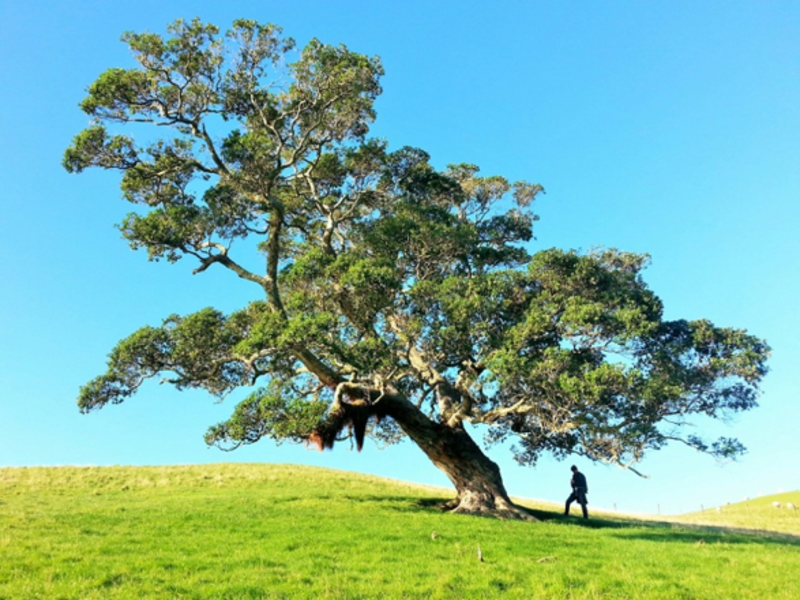
As a metaphor, Job’s suffering mirrors the suffering of creation, of which God is the Creator. We know that every time humanity interacts with creation, creation feels the intervention and speaks, although humanity often doesn’t listen. Creator and creation feel and react to every tree that is cut down, and to every instance of mining the earth. Everything we have comes from the earth, and nothing happens in isolation from the whole, even if we don’t or won’t see what’s outside the frame. I have my own particular and peculiar limited view about some parts of creation. I am literally a tree hugger - I want to hug all the trees but it would slow me down on my walks, and you do get some funny looks. But I’m sad and angry when trees are chopped down to build more commercial buildings. When I find a spider inside, I always try to relocate it outside - but if an earwig gets in the house, it’s usually a goner. [Sidebar: who am I to kill a creature that God made because I find it creepy? A quick bit of research taught me that earwigs are not harmful or poisonous to humans and they eat aphids. I’m going to try to respect earwigs. I don’t think I’ll hug them, though.] Anyway… trees. Trees are more than beautiful things or resources for us to use. Job finds hope in the regenerative abilities of trees. Job 14, verses 7-9 reads
For a tree has hope:
though cut down, it can still be removed,
and its shoots will not cease.
Though its roots grow old in the ground
and its stock die in the dust,
from the scent of water it flowers,
and puts forth branches like a sapling.
There is so much hope in the ideas in those lines! Re-birth, regeneration, even resurrection. At the same time, as Bruce Cockburn asked, “if a tree falls in the forest, does anybody hear the forest fall?” Another question is, does anybody hear creation cry?
Since the story of Job was written, scientists have learned so much more about trees. We know that they are living beings that can experience sensation. In his book The Hidden Life of Trees, Peter Wohlleben describes how trees interact with their environment and one another. Trees’ root systems are similar to the human brain. Roots transmit signals and share information, forming a sophisticated communication network. Trees are capable of learning, they have a sense of time, and they have distinct personalities. The unseen tree brain spreads out underground, with each
root tip acting like a mini control centre … allow[ing] trees to detect water, absorb nutrients, and even interact with neighbouring trees, sharing resources and sending distress signals. Trees have a wisdom we can only marvel at.
How then shall we live, with responsibility for the damage humanity has caused to creation, and with the desire to save what we can for our children and grandchildren? It’s our work to expand our view and learn to see ourselves in relationship. This is not an easy task but it’s attainable, and it’s worth the effort. It takes patience. Wisdom doesn’t just happen, it comes through struggle, suffering, and the transformation that suffering brings. Wisdom has to learn to be wise. In his commentary on Job, Walter Brueggemann notes that the world is ordered with and by wisdom, but this wisdom is unavailable for human scrutiny. Humanity can mine for treasure of various types (in other words, bring hidden things to light with technology which causes creation to suffer) but it’s a mistake to think we can uncover or unearth wisdom. It’s when we endure suffering that we realize we are really seeking hope, as much as wisdom. Maybe we humans are in the process of getting wiser. Maybe what is happening in the world, the groaning and suffering of creation, is part of that process. What would this getting wiser look like? I think of David Suzuki and Greta Thunberg and others like them in answer to that question — people whose life work is to open humanity’s eyes to the needs of creation. We have a role in the process too, especially from a theological point of view. We can learn to be wise by
observing and being curious about the world around us. We can find wisdom in creation and learn from her. Job’s imagination is stretched by pondering his suffering. Similarly, our work is to broaden our focus, to zoom out from our own lives and consider the bigger picture, the things outside the frame of those pristine paintings of nature we like to look at. And I want to be clear here. I don’t know any of you very well. I don’t your stories yet but I know there are people here who already see the bigger picture. Thank you! As you listen, I invite you to consider whether
your job might be helping the rest of us to see the big picture of creation - the good, the bad, and the ugly - a little more clearly.
We can see re-birth, regeneration and resurrection every day in creation when we look at trees. Trees contain the wisdom of creation that we can only yearn for. The mystery of creation is so vast, and we know so very little. And yet, on this Thanksgiving weekend and on every day, we have so much to be thankful for. One of the commentaries I read suggests that “even God must ‘find’ wisdom by following a path that brings God to a place where it exists.” It could be
troubling to think that wisdom is something even God has to find, instead of something internal, but I see this as proof that God is constantly at work in creation, seeking out wisdom. The gift of living in creation, the grace of God, the pull toward something beyond our understanding - these are the blessings of wisdom. Amen