
Joyce Wagland's Reflection Pentecost 12, 2026 Grace Without Borders
Genesis 45:1-15: 45 Then Joseph could no longer control himself before all his attendants, and he cried out, “Have everyone leave my presence!” So there was no one with Joseph when he made himself known to his brothers. 2 And he wept so loudly that the Egyptians heard him, and Pharaoh’s household heard about it.
3 Joseph said to his brothers, “I am Joseph! Is my father still living?” But his brothers were not able to answer him, because they were terrified at his presence.
4 Then Joseph said to his brothers, “Come close to me.” When they had done so, he said, “I am your brother Joseph, the one you sold into Egypt! 5 And now, do not be distressed and do not be angry with yourselves for selling me here, because it was to save lives that God sent me ahead of you. 6 For two years now there has been famine in the land, and for the next five years there will be no plowing and reaping. 7 But God sent me ahead of you to preserve for you a remnant on earth and to save your lives by a great deliverance.
8 “So then, it was not you who sent me here, but God. He made me father to Pharaoh, lord of his entire household and ruler of all Egypt. 9 Now hurry back to my father and say to him, ‘This is what your son Joseph says: God has made me lord of all Egypt. Come down to me; don’t delay. 10 You shall live in the region of Goshen and be near me—you, your children and grandchildren, your flocks and herds, and all you have. 11 I will provide for you there, because five years of famine are still to come. Otherwise you and your household and all who belong to you will become destitute.’
12 “You can see for yourselves, and so can my brother Benjamin, that it is really I who am speaking to you. 13 Tell my father about all the honor accorded me in Egypt and about everything you have seen. And bring my father down here quickly.”
14 Then he threw his arms around his brother Benjamin and wept, and Benjamin embraced him, weeping. 15 And he kissed all his brothers and wept over them. Afterward his brothers talked with him.
Matthew 15:10-28: 10 Jesus called the crowd to him and said, “Listen and understand. 11 What goes into someone’s mouth does not defile them, but what comes out of their mouth, that is what defiles them.”
12 Then the disciples came to him and asked, “Do you know that the Pharisees were offended when they heard this?”
13 He replied, “Every plant that my heavenly Father has not planted will be pulled up by the roots. 14 Leave them; they are blind guides.[a] If the blind lead the blind, both will fall into a pit.”
15 Peter said, “Explain the parable to us.”
16 “Are you still so dull?” Jesus asked them. 17 “Don’t you see that whatever enters the mouth goes into the stomach and then out of the body? 18 But the things that come out of a person’s mouth come from the heart, and these defile them. 19 For out of the heart come evil thoughts—murder, adultery, sexual immorality, theft, false testimony, slander. 20 These are what defile a person; but eating with unwashed hands does not defile them.”
21 Leaving that place, Jesus withdrew to the region of Tyre and Sidon. 22 A Canaanite woman from that vicinity came to him, crying out, “Lord, Son of David, have mercy on me! My daughter is demon-possessed and suffering terribly.”
23 Jesus did not answer a word. So his disciples came to him and urged him, “Send her away, for she keeps crying out after us.”
24 He answered, “I was sent only to the lost sheep of Israel.”
25 The woman came and knelt before him. “Lord, help me!” she said.
26 He replied, “It is not right to take the children’s bread and toss it to the dogs.”
27 “Yes it is, Lord,” she said. “Even the dogs eat the crumbs that fall from their master’s table.”
28 Then Jesus said to her, “Woman, you have great faith! Your request is granted.” And her daughter was healed at that moment.
May the words of my mouth and the meditations of all our hearts be reflections of your word to us. Amen
There are some days when it feels as though the whole world has forgotten how to be neighbours.
Open the newspaper—or perhaps don't, if you'd like to preserve your blood pressure. Turn on the television. Scroll through your iPad or your phone. Everywhere we look, people are dividing themselves into camps. Nations are suspicious of one another. Some political leaders trade insults more readily than ideas. Our neighbours to the south continue to experience profound political instability, with fierce polarization leaving many people anxious about the future of their democracy. Families are divided. Communities are fractured. Trust is in short supply. And then we arrive at church and hear two stories that ask a very uncomfortable question:
What happens when God refuses to divide the world the way we do?
Both our readings are about boundaries. In Genesis, there is a family boundary. Joseph has every reason to keep his brothers at arm's length. These are the brothers who threw him into a pit, sold him into slavery, and then lied to their father for years. If anyone deserved to say, "You made your choice. Live with it," it was Joseph. Instead, he weeps. Not a polite tear. The scripture says he cries so loudly that everyone in Pharaoh's household hears him. And then comes this astonishing line:
"I am Joseph. Is my father still alive?"
Notice what he doesn't say.
He doesn't say, "Remember what you did to me?"
He doesn't say, "You owe me an apology."
He doesn't even say, "I forgive you."
Instead, he begins by restoring relationship. And then, forgiveness becomes possible.
That doesn't erase the past. Joseph doesn't pretend evil never happened. But he refuses to let the worst thing his brothers ever did become the last thing that defines them. That is difficult enough. Then Jesus makes it even more difficult.
The encounter with the Canaanite woman has puzzled Christians for a long time. Before Jesus ever meets the Canaanite woman, he has already begun challenging the boundaries that people believed God had established.
The religious leaders are worried because the disciples have not washed their hands according to the ritual traditions. But Jesus turns the whole discussion upside down. "It is not what goes into the mouth that defiles a person," he says, "but what comes out."
Imagine how shocking that would have sounded. For generations, faithful people had carefully distinguished between clean and unclean food, clean and unclean practices, clean and unclean people. Those rules weren't just about hygiene—they were about identity. They marked out who belonged and who didn't.
Jesus doesn't dismiss holiness. Instead, he moves the conversation from the outside to the inside. God's concern is not with the dirt on our hands but with the condition of our hearts. Anger, hatred, deceit, cruelty, prejudice—these are what truly make us unclean. Compassion, mercy, forgiveness, and love—these are the signs of a heart shaped by God.
And then Matthew immediately tells us the story of the Canaanite woman. That is no accident. Jesus has just challenged the idea that people can be divided into "clean" and "unclean." Now he shows what that teaching looks like in practice.
Frankly, Jesus doesn't seem very...Jesus-like. A desperate mother begs for help for her daughter. Jesus ignores her. The disciples want to send her away. Then Jesus says he was sent only to the lost sheep of Israel. Finally comes the line that makes us wince: "It is not fair to take the children's food and throw it to the dogs."
It's uncomfortable. It should be. Perhaps that's exactly the point.
The woman refuses to be silenced. She doesn't argue about theology. She simply insists on the abundance of God's mercy.
"Even the dogs eat the crumbs that fall from their master's table."
What remarkable courage. She is not asking for someone else's blessing. She is saying that God's grace is abundant enough for everyone.
And Jesus responds,
"Woman, great is your faith."
She changes the conversation. Or perhaps she reveals where the conversation was always meant to end. Because by the end of Matthew's Gospel, Jesus sends the disciples not only to Israel, but to all nations.
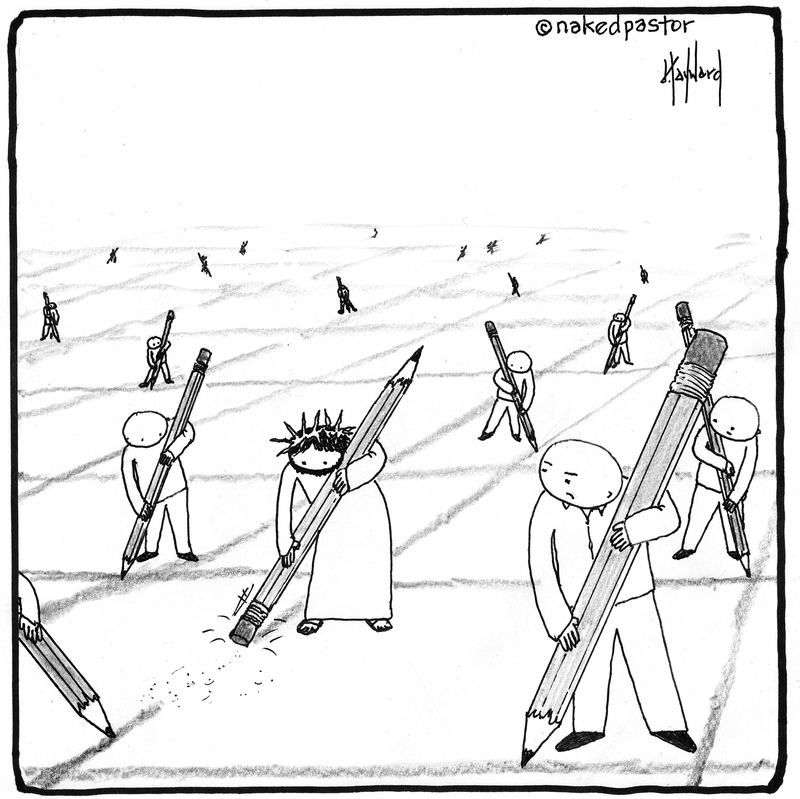
The circle has become wonderfully, gloriously wider.
I sometimes think the Church has spent two thousand years trying to catch up with that Canaanite woman. She knew something we still struggle to believe: There is enough grace. Enough love. Enough room. Enough welcome.
Our congregation has chosen to describe itself as an affirming congregation. That isn't simply a statement about who may walk through our doors. It's a declaration about who God is. It means we believe that God's welcome is always larger than our assumptions. That every human being bears the image of God. That Christ continually stretches our hearts beyond the boundaries we would naturally draw.
And if we're honest, every one of us has boundaries we'd rather keep. Some are political. Some are cultural. Some are generational. Some are deeply personal.
We may find it easy to love people who think as we do. It becomes much harder when someone wears a different political button, flies a different flag, or posts things online that make us shake our heads. The temptation today is to sort everyone into categories: good people and bad people, insiders and outsiders, "our people" and "those people."
The Gospel keeps interrupting those neat categories.
Living here on Vancouver Island, surrounded by the sea, perhaps we understand something about boundaries. The ocean can seem like an edge. Stand at Goose Spit or look across Baynes Sound, and it feels as though the water separates us from somewhere else.
But sailors know better. The sea is not only a boundary. It is also a connection.
For thousands of years, these waters have connected peoples and cultures. Long before European settlers arrived, the K'ómoks people travelled these waters as highways, not barriers. Ferries still connect us to the mainland. Fishing boats head out before dawn. Whales ignore the borders we draw on maps. The sea teaches us that what looks like a dividing line may actually be an invitation to relationship.
That may be one of God's favourite lessons.
Joseph crossed the sea of betrayal.
The Canaanite woman crossed the sea of prejudice.
Jesus crossed the sea between "us" and "them."
And he invites us to do the same.
That doesn't mean pretending injustice doesn't exist. Joseph still names what happened. Jesus still speaks honestly. The Church must still speak clearly for justice, for truth, for compassion, and for the dignity of every human being. When political leaders sow fear instead of hope, Christians cannot simply shrug. When vulnerable people are targeted, we cannot remain silent. When democracy itself feels fragile, we pray, we participate, and we remember that our ultimate allegiance belongs not to any nation or party but to the reign of God.
At the same time, we remember something else.
The people across the border are not our enemies. Millions of Americans are frightened by the divisions within their own country. Many are working courageously for justice, peace, and reconciliation. They are our neighbours, our friends, our family members. The Gospel does not permit us to demonize them any more than Joseph demonized his brothers. Or Jesus dismissed the Canaanite woman.
Perhaps the greatest miracle in today's readings is not that Joseph forgives. Not even that Jesus heals. The greatest miracle is that people who had every reason to remain separated discover they belong to one another after all. Surely that is God's dream.
And perhaps it begins in small ways. A difficult conversation. A listening ear. A willingness to admit we might not have the whole story. A table where everyone has a place.
Every Sunday, we practise that miracle. We gather from different backgrounds, different experiences, different opinions. Some of us are confident in our faith. Some of us are quietly doubting. Some are joyful. Some are grieving. Some have always felt welcome in churches. Others have spent years wondering if there was room for them.
Yet Christ says to every one of us:
"Come."
Not because we've earned our place. But because grace is bigger than we imagined. Joseph discovered that. The Canaanite woman knew it all along. May we have the courage to believe it.
And may the world, looking at the Church, catch a glimpse of that larger, wider, deeper love—a love as wide as the ocean that surrounds us, and far deeper still.
Thanks be to God.
Amen.