
Karen Hollis | Aug 2, 2026 10th Sunday after Pentecost
First Reading: Qur'an An-Nisa 4:36
Worship Allah ˹alone˺ and associate none with Him. And be kind to parents, relatives, orphans, the poor, near and distant neighbours, close friends, ˹needy˺ travellers, and those ˹bondspeople˺ in your possession. Surely Allah does not like whoever is arrogant, boastful.
Second Reading: Deuteronomy 6:4-5 & Leviticus 19:17-18
“Listen, O Israel! The Lord is our God, the Lord alone. And you must love the Lord your God with all your heart, all your soul, and all your strength. “Do not nurse hatred in your heart for any of your relatives. Confront people directly so you will not be held guilty for their sin. Do not seek revenge or bear a grudge against a fellow Israelite, but love your neighbor as yourself. I am the Lord.”
Gospel Reading: Matthew 22:36-40
“Teacher, which is the most important commandment in the law of Moses?” Jesus replied, “‘You must love the Lord your God with all your heart, all your soul, and all your mind.’ This is the first and greatest commandment. A second is equally important: ‘Love your neighbor as yourself.’ The entire law and all the demands of the prophets are based on these two commandments.”
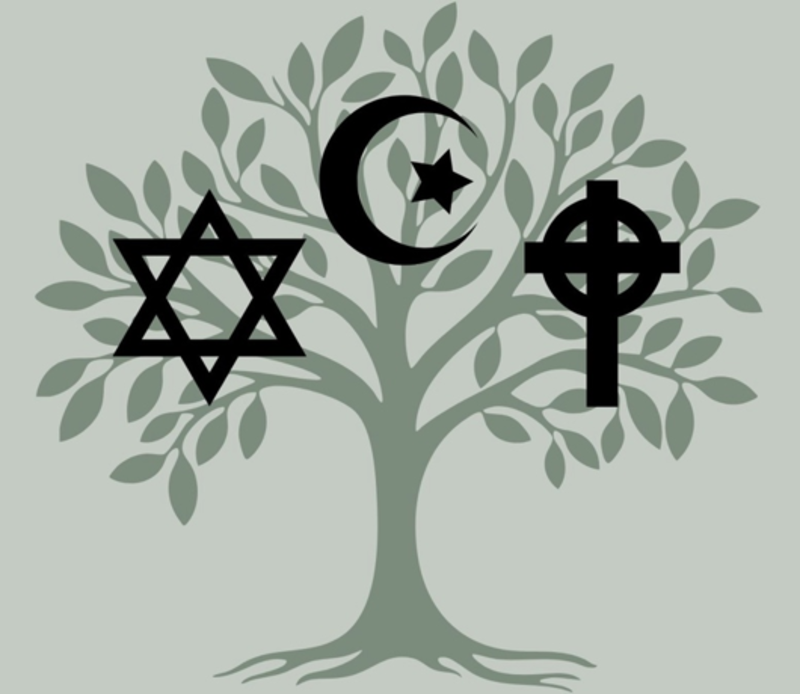
Aren’t the similarities incredible? Obviously in the gospel reading, Jesus is quoting those Hebrew Bible excerpts, but he’s doing so because they are important . . . and they are also so similar to the verses from the Qur’an. As we bring the three traditions together, we see right away spaces of intersection.
Let us pray . . . May the words of my mouth and the meditations of all our hearts be reflections of your word to us today, in Christ’s name we pray. Amen
When I did campus ministry at UBC I was a member of the Multifaith Chaplain’s Association. All of us chaplains, from different faiths, gathered twice a month to learn about one another’s traditions and at times collaborate. Those at the table were Christian, Baha’i, Jewish, Sikh, Muslim, Buddhist, and Zen Buddhist. The name multifaith meant to lift up the many faith traditions represented. Another word that is commonly used in these contexts is Interfaith. Interfaith is a little different in that it “points toward activities or relationships between people with different beliefs or faith identities.”1 It emphasizes the relationships between traditions.
In the Multifaith organization, our primary point of collaboration was orientation week at UBC, where we would stand together behind a table at information fairs as new students streamed by. Some of the most important ministry we did collectively was simply being present together to show students from all over the world that we were friends. Sometimes their eyes would widen, they walked by the table fixed on the scene: a Sikh talking to a Jew, a Muslim talking to a Baha’i, a Catholic talking to a protestant. Multifaith and interfaith are important on so many levels, including modeling relationship for others. It is important for us to be in relationship, in part, because it serves the greater whole that is so fraught and in so much pain.
This morning the Multifaith organization in the valley is hosting a worship service. We started gathering maybe 2 years ago. There were probably 20 people at the first few gatherings. The leadership of the multifaith group has been really good at leading an open and collaborative process of discerning the purpose of our group. It’s an important piece to address, because we all come to the table with different contexts, ideas, expectations, pain points, and needs. As we shared, what came forth most clearly was again the importance of gathering, itself, the importance of being in relationship. What a beautiful starting place.
Where do we go from there in the context of Multifaith and Interfaith? Even when we come with generosity and the best of intentions, with the potential to move into some rich and inevitably challenging spaces, we want to proceed with care. Thankfully, those who have walked this road before us developed some guidelines and best practices for interfaith engagement. I think they’re helpful for just getting our heads around this world that exists between traditions. They begin on the next slide:
1. First, we agree that we are here to learn and grow and see the world through the eyes of another.
2. Dialogue happens between people of different faith traditions, but it is also important for us to return to our communities and share with them the fruits of what we learn so we can move forward together.
3. It is so important to come authentically with honesty and sincerity, which might be obvious, but still important to name.
4. The fourth distinguishes between the ideals of a particular tradition and how that tradition is practiced in any given community. We know that we can never fully embody the ideals . . . yet we practice. So we don’t compare ideals of one with the practice of another. Ideal to ideal, practice to practice.
5. Each person defines themselves. So I might say, I’m Christian and this is what it means for me to be Christian. Christian might mean something different to someone else, so each of us names what it means for us to embody our tradition.
6. This is about openness. We’re not deciding ahead of time how the conversation is going to go or where places of disagreement may be. We come with openness to the other to learn and likely be surprised.
7. For dialogue to take place, there needs to be a baseline of equality, an affirmation that no individual or path is above another. Again, it’s important to name.
8. Trust doesn’t happen right away, but with openness and generosity, starting slowly and on common ground, trust grows and creates a foundation for further exploration.
9. It’s important that we come with at least a minimal amount of awareness of our own human limitations, as well as awareness of the gifts and shadows of our own traditions so that we don’t come thinking we have all the answers.
10. And finally, purpose of dialogue, again, is to learn and grow and see another perspective, see through someone else’s eyes. So through dialogue, the intent is to try on the tradition of another and experience it from within . . . not to be converted, but in order to grow as a human being.
In a way, interfaith is about seeing more of the holy. Here in the United Church, we affirm God’s initiating presence in the world . . . I think the holy has always shown up in the context of our cultures, in ways the people in each context can perceive and connect to . . . and so of course our traditions look different from one another. Each tradition is given a gift that is truth, but not the whole truth. And even if we bring together the collective truth gifted to us, there is still more holy mystery to encounter.
There also seem to be these spaces of overlap, these spaces that resonate so deeply that they are heard across faith traditions and practiced widely . . . such as, love and kindness. These common spaces teach us to love the holy one who gives life and sustains life . . . to care for one another, care for the vulnerable, and be in relationship with one another in a good way. With so much active conflict in the world, it’s easy to assume we understand what we see and hear. But we don’t really know until we listen. Being human isn’t easy . . . though there is such beauty and heart in coming together and experiencing the holy spaces between us. Thanks be to God.
1 Mackenzie, Falcon, Rahman. Getting to the Heart of Interfaith. p. 6.